What Is GEO? A Data-Driven Guide to Brand Visibility in AI Search
Instead of typing “digital marketing agency in Istanbul” into a search box, a user now asks ChatGPT and gets three names in a single paragraph. If you are not in that paragraph, it doesn’t matter where you rank in classic search — for that user, you are invisible. GEO (Generative Engine Optimization) is the discipline of being visible in exactly this new layer — and the good news is that its foundations are still familiar.
What is GEO? Where the term comes from and what it means
GEO, short for Generative Engine Optimization, is the work of increasing the likelihood that your content is cited as a source and your brand is mentioned in the answers produced by generative AI systems such as ChatGPT, Google AI Overviews, Gemini and Perplexity.
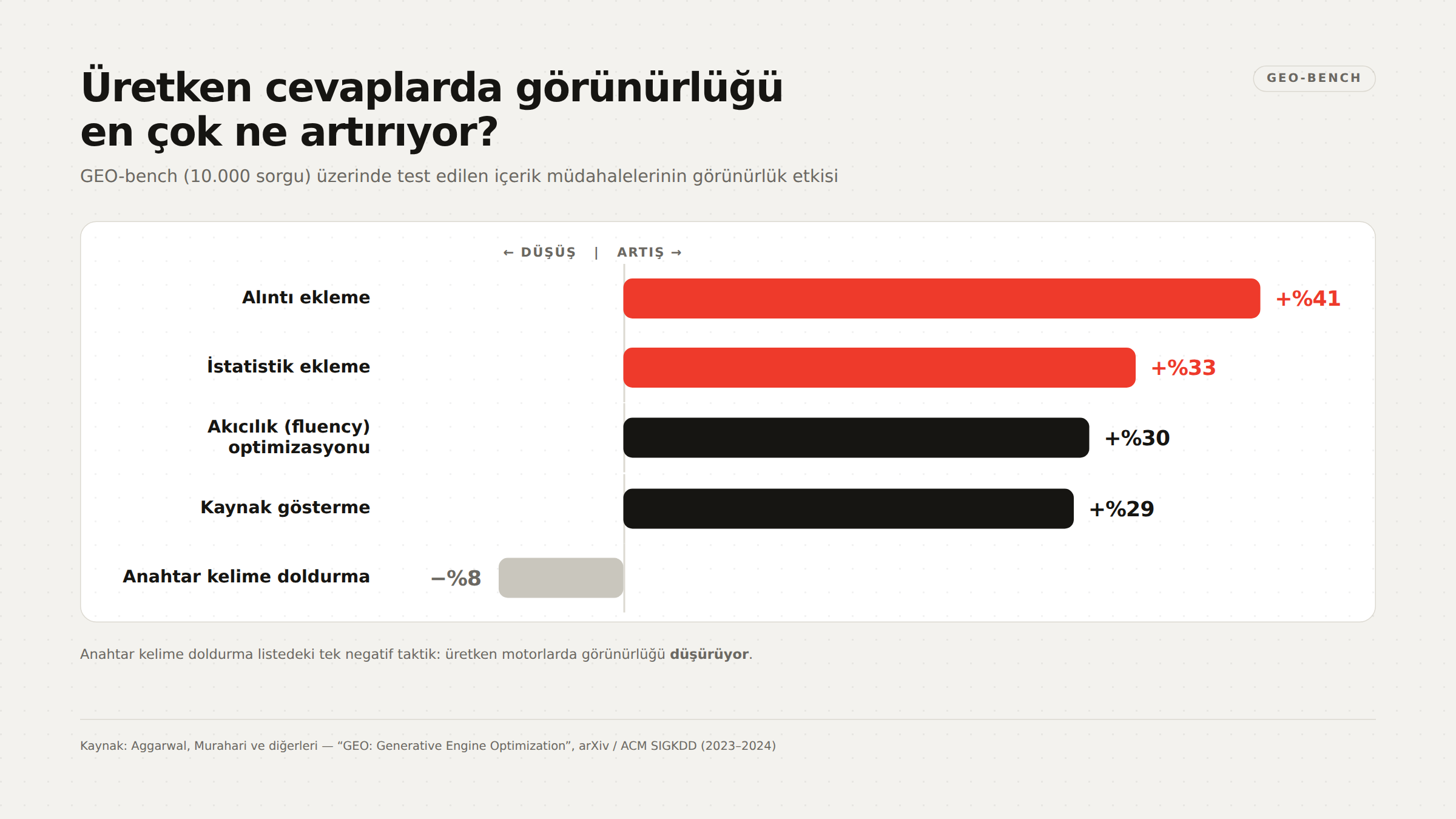
The term is not a buzzword invented by marketers; it comes from academic research. The paper “GEO: Generative Engine Optimization”, published on arXiv in November 2023 by Pranjal Aggarwal, Vishvak Murahari and colleagues and presented at the ACM SIGKDD conference in 2024, was the first to study the topic systematically. Using a benchmark of 10,000 queries called GEO-bench, the researchers tested nine different content interventions and reported visibility gains of up to 40% in generative answers.
The paper’s most instructive finding was which interventions actually worked:
- Quotation Addition: up to a 41% increase in visibility (41–44%, depending on the visibility metric used)
- Statistics Addition: 33%
- Fluency optimization: 30%
- Cite Sources: 29%
- Keyword Stuffing: an 8% decrease
In other words, old-school keyword stuffing backfires in these systems, while verifiable data, clear quotations and cited sources are rewarded. The paper also stresses that the effect varies by industry — there is no single universal recipe.
AEO, LLMO, AI SEO: how are they different from GEO?
The acronyms floating around the market are confusing. In practice, the differences can be summarized like this:
- AEO (Answer Engine Optimization): An older concept than GEO. It aims to format content so that it answers questions directly, targeting featured snippets, “People Also Ask” boxes and voice assistant answers.
- GEO: Focuses on the scenario in which the answer is generated. The model doesn’t copy your page; it reads, synthesizes and writes its own sentences. The goal here is to be part of that synthesis, as a source or as a brand.
- LLMO / AI SEO / GAIO: Marketing labels that describe largely the same work. There is no common industry standard yet; which term an agency prefers doesn’t change what the work involves.
Google’s own official documentation largely rejects these distinctions. Search Central’s “AI Optimization Guide” puts it this way:
“there are no additional requirements to appear in AI Overviews or AI Mode”
(In plain terms: there is no special extra step required to show up in AI Overviews or AI Mode.)
— Google Search Central
According to Google, optimizing for generative search is still optimizing for search itself. That doesn’t make GEO unnecessary: engines outside Google (ChatGPT, Perplexity, Claude) draw on different sources, and Google doesn’t describe the dynamics at work there. A solid technical and content SEO foundation is a prerequisite for GEO — but on its own, it isn’t enough.
Why are users asking ChatGPT and Gemini?
Adoption data shows how fast this shift is happening. According to a Pew Research Center survey of 5,119 U.S. adults conducted February 17–23, 2026:
- 49% of U.S. adults use an AI chatbot (up from 33% in 2024).
- 44% say they use ChatGPT — more than double the 18% recorded in 2023.
- 42% of chatbot users use these tools to look up information, the most common purpose on the list.
- 12% use them several times a day, and 8% once a day.
The “How People Use ChatGPT” study prepared by OpenAI researchers for NBER (September 2025) points to a similar picture: based on data from November 2022 – July 2025, ChatGPT had reached roughly 10% of the world’s adult population as of July 2025, and about 80% of conversations fall into three categories: practical guidance, seeking information and writing.
On the scale side, according to Alphabet’s Q2 2026 earnings remarks, Google’s AI Mode has passed 1 billion monthly active users, and the Gemini app has reached 950 million monthly active users.
An important caveat: this is not a one-player market, and it is changing fast. According to Similarweb measurements for June 2025 – May 2026, ChatGPT’s share of visits to generative AI sites fell from 76% to roughly 53%, while Gemini rose from under 9% to the 27–28% range and Claude from 2% to 9%. Over the same period, total monthly visits to these platforms grew 70% year over year to 9.5 billion. Optimizing for a single platform is a risky bet.
How do AI Overviews and AI summaries affect clicks?
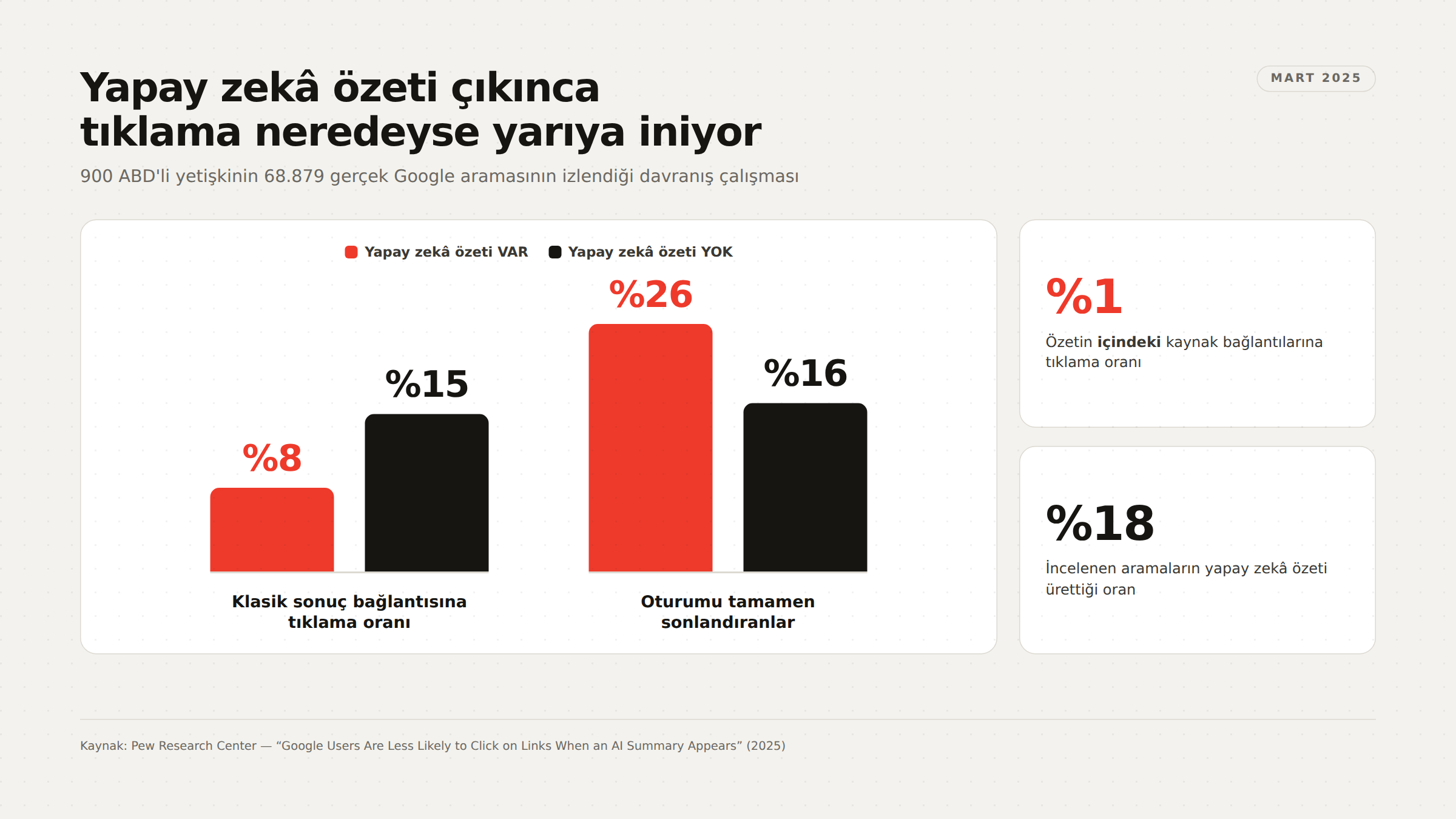
This is the most debated part of the topic, and the one generating the most data. A Pew Research Center study that tracked 68,879 real Google searches made by 900 U.S. adults in March 2025 paints a clear picture:
- On searches that showed an AI summary, 8% of users clicked a traditional result link; on searches without a summary, the rate was 15%.
- The click rate on the source links inside the summary was just 1%.
- On pages with a summary, 26% of users ended their session entirely; on pages without one, 16% did.
- 18% of the searches studied produced an AI summary.
Google, for its part, said over the same period that its AI features “send billions of clicks to websites every week” and that search revenue grew 17% year over year in Q2 2026. The two pictures don’t fully contradict each other: total search volume can be growing while the probability of a click per search is falling. To be honest — the industry doesn’t yet have an independent measurement that cleanly separates these two effects. What is certain is this: visibility is no longer synonymous with clicks.
Where does a language model learn about your brand?
1. Training data
The model acquires a static “memory” of your brand from the web archive of the period it was trained on. You can’t control this layer directly, and its freshness is limited — a newly founded brand may not appear in it at all.
2. Live search and RAG
Most modern systems run a live search while generating an answer (RAG — retrieval-augmented generation). Google describes this behavior as “query fan-out”: for a single user question, multiple related searches run in the background and a broader set of sources is scanned. From a GEO perspective, this is the layer you can influence most: if your page can’t be crawled and indexed, it can’t make it into that set.
3. Structured data and machine readability
Schema.org markup helps the model interpret your page correctly, but Google explicitly warns: “You don’t need to add any special schema.org structured data to appear in AI Overviews.” Structured data is still valuable for rich results and entity clarity — it just isn’t a magic GEO key.
4. Third-party mentions
This is the most critical layer. According to a study Dmitrij Zatuchin published on arXiv in June 2026, which analyzed 167,551 source citations for 128 brands across 12 markets and 13 languages, 85.7% of the sources models cite point to sites the brand doesn’t own, and only 14.3% to the brand’s own properties. Roughly 80% of citations come from just 18% of domains, and Wikipedia is the most-cited domain in 11 of the 12 languages tested.
In short: what others write about your brand carries roughly six times more weight than what you write yourself.
Practical GEO work
Content structure and quotability
Models struggle to extract sentences from long, meandering paragraphs. A practical rule: under every subheading, the first 2–3 sentences should answer that heading’s question directly. In line with the findings of the GEO paper, back up your claims with dated statistics, named sources and short quotations. According to Ahrefs data, AI platforms prefer content that is 25.7% fresher than what gets cited in classic organic results; 76.4% of ChatGPT’s most-cited pages were updated within the last 30 days. Make your update date visible — and genuine.
Question-and-answer format
The questions users ask AI are longer and more conversational than classic keywords. Use real question sentences as H2/H3 headings in your content, and beneath each one write a self-contained, copyable answer paragraph of 40–60 words. That paragraph should make sense even when lifted out of context.
Schema / JSON-LD
Set up Organization, FAQPage, Article, Product and BreadcrumbList schemas correctly. The golden rule: your structured data must match the visible text on the page exactly. Mismatched markup creates both a manual action risk and a loss of trust in the eyes of the model.
Entity clarity
To make sure the model doesn’t confuse “BeSight House” with another brand, consolidate your entity signals: consistent spelling of the brand name, a single canonical “About” page, and the same address, the same founding year and the same service description on Google Business Profile, LinkedIn, industry directories and, if possible, Wikidata. This consistency starts with a well-planned corporate website architecture; for details, take a look at our corporate web design and conversion guide.
Digital PR and earning mentions
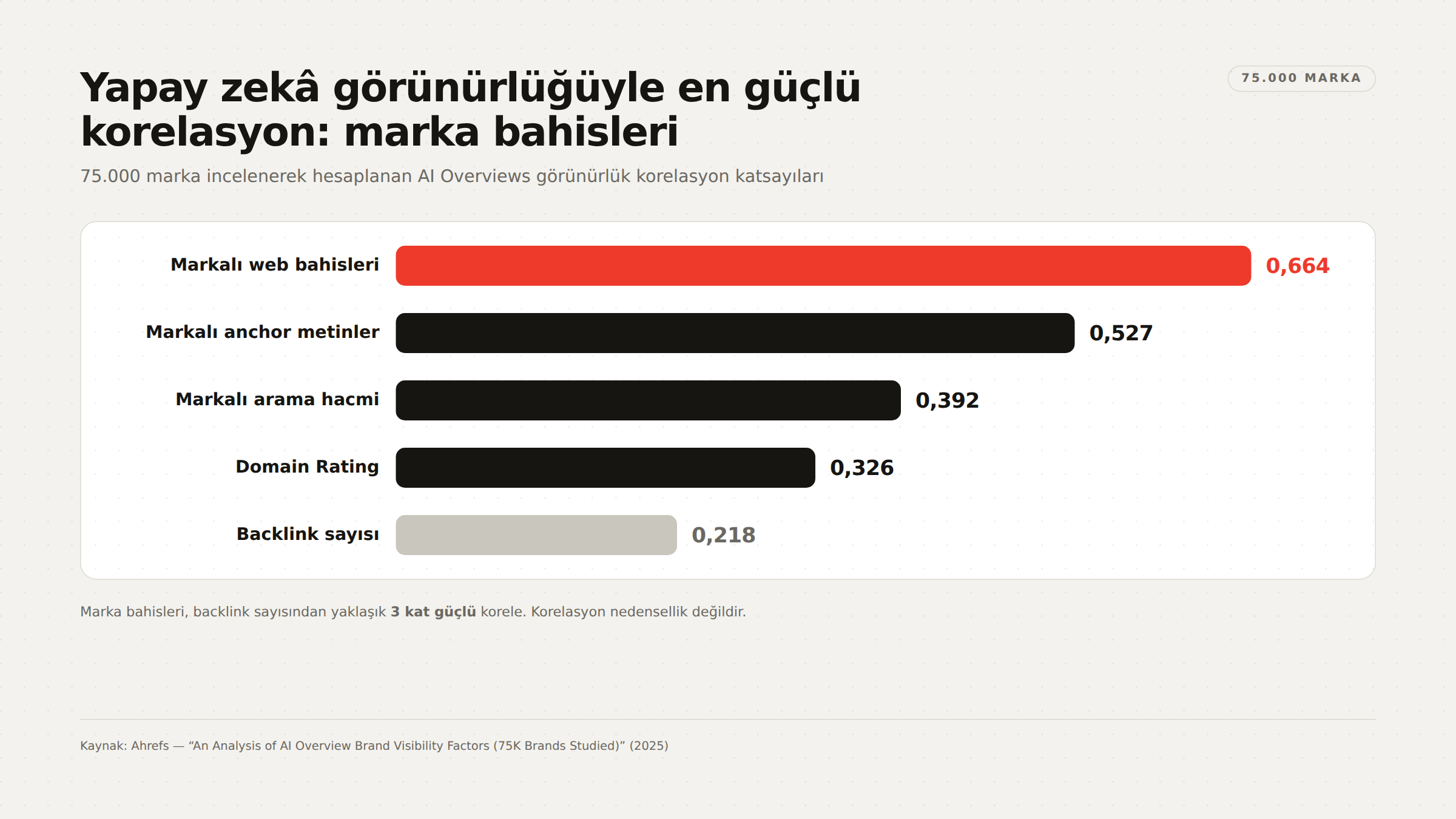
Ahrefs’ study of 75,000 brands (May 2025) clearly identifies the factor with the strongest correlation to AI Overviews visibility:
- Branded web mentions: 0.664
- Branded anchor text: 0.527
- Branded search volume: 0.392
- Domain Rating: 0.326
- Number of backlinks: 0.218
Mentions correlate roughly three times more strongly than backlinks. Brands in the top 25% for web mentions get 10 times more AI visibility than the rest. Remember that correlation is not causation — but the practical takeaway is clear: even an unlinked mention on a news site is valuable. That is why industry publications, podcast guest spots, data-driven research and placements in comparison lists matter.
The llms.txt debate
The llms.txt file, discussed since 2024, proposed a text file that summarizes your site’s content for language models. The data doesn’t support the idea. According to an Ahrefs study of 137,210 domains in May 2026, 97% of llms.txt files never received a single request from any source; of the requests to files that were read, 19.5% came from AI bots, but retrieval bots — the ones that actually fetch content — accounted for just 1.1%.
“an llms.txt file is largely decoration”
(In plain terms: the file does little more than sit there.)
— Ahrefs
Google has also stated officially that it ignores these files and that they do “neither good nor harm” for visibility. Adding one is harmless; mistaking it for a GEO strategy is a waste of time.
How do you measure GEO? Tracking brand mentions
Measurement is the hardest part of GEO. Classic rank tracking doesn’t work here because the same model can give two different answers to the same question. A workable measurement framework looks like this:
- Build a prompt set. Lock in 30–50 questions your customers would genuinely ask (category, comparison, “best X”, problem-driven).
- Run it at regular intervals. Measure the same set on ChatGPT, Gemini, Perplexity and AI Overviews every week or every two weeks.
- Record three metrics: mention rate (how many answers mentioned you), citation rate (how many answers cited your site as a source) and context/tone (leader, alternative or negative).
- Separate referral traffic. In GA4, track sources such as chatgpt.com, perplexity.ai and gemini.google.com in a dedicated channel group.
Two reference points to set the right expectations: according to Similarweb, the citation rate in ChatGPT answers in the U.S. rose from 1.6% in June 2025 to roughly 6.8% in May 2026, with big differences by industry — around 23% in travel/hospitality and around 20% in automotive, but under 4% in professional services. In Ahrefs’ own data, AI-referred visits make up just 0.5% of total traffic yet bring in 12% of sign-ups. Low volume, high intent — so evaluate GEO by qualified demand, not by traffic.
“Rankings don’t guarantee visibility in AI search.”
(In plain terms: a top position on Google no longer means you will show up in AI answers.)
— Search Engine Land
How SEO and GEO relate
GEO doesn’t replace SEO; it builds on it. According to Ahrefs data, 76% of AI Overviews citations come from pages that rank in Google’s top 10 organic results. In other words, your classic rankings are a prerequisite for appearing in Google’s AI layer. By contrast, when all AI platforms are considered together, only 12% of citations rank in Google’s top 10 — engines such as ChatGPT and Perplexity draw on different source pools.
| Dimension | Classic SEO | GEO |
|---|---|---|
| Goal | Ranking high on the results page | Being mentioned / cited as a source within the generated answer |
| Unit | URL and keyword | Entity, claim and passage |
| Success metric | Rankings, clicks, organic sessions | Mention rate, citation rate, positioning within the answer |
| Key signals | Backlinks, technical health, content relevance | Third-party mentions, data/quotation density, freshness, entity consistency |
| Content format | Comprehensive guide pages | Self-contained, sourced Q&A blocks |
| Measurement | Search Console, rank tracker | Fixed prompt set + manual/tool-assisted monitoring |
| Nature of results | High volume, variable intent | Low volume, high intent |
In practice, the two disciplines should be run by the same team. That is why our GEO service never starts without auditing your existing SEO foundation; for the basics, read our guide to what SEO is. For brands that want to accelerate demand while organic visibility matures, Google Ads and Meta Ads play a complementary role — our Google Ads campaign management guide is a good place to start with campaign setup.
The situation in Turkey
According to TÜİK’s (the Turkish Statistical Institute’s) first-ever AI Statistics release (2025), 19.2% of people in Turkey say they use generative AI. The age breakdown shows where the shift is coming from:
- Ages 16–24: 39.4%
- Ages 25–34: 30%
- Ages 35–44: 15.5%
- University graduates: 36.1%
On the business side, the AI usage rate among enterprises in Turkey rose from 2.7% in 2021 to 7.5% in 2025; among companies with 250+ employees, it is 24.1%. In other words, individual adoption in Turkey is well ahead of corporate adoption — your customers may already be asking AI about your brand, but most of your competitors haven’t yet positioned themselves in this layer. That is a real gap for early movers.
One more caveat: Zatuchin’s multilingual study shows that citation sources vary significantly from market to market. Turkish-language content and Turkish third-party mentions can’t be replaced by their English equivalents when it comes to visibility in the Turkish market. Local industry publications, Turkish Wikipedia, and a presence on Turkish forums and directories shouldn’t be neglected. Your social media presence is also part of this mention ecosystem.
Common mistakes
- Treating GEO as a replacement for SEO. If your page isn’t indexed or is closed to snippets, it can never make it into Google’s AI layer.
- Mistaking llms.txt for a strategy. The data shows this file is practically never read.
- Churning out unsourced, AI-generated volume content. GEO research shows that visibility gains come from verifiable data and quotations, and that keyword stuffing backfires.
- Optimizing for a single platform. Market shares shifted dramatically within 12 months; Gemini and Claude gained significant share.
- Treating a single answer as proof. Models are probabilistic; don’t build a strategy on a one-off output — measure the trend.
- Skipping mention building. Optimizing only your own site falls short in an environment where 85.7% of citations come from external sources.
- Letting structured data and page text drift apart. Marking up content that isn’t visible creates risk.
Frequently asked questions
Will GEO replace SEO?
Based on current data, no. Google states clearly that optimizing for generative search is still search optimization and that there are no additional requirements to appear in AI Overviews. What’s more, 76% of AI Overviews citations come from pages in Google’s top 10 organic results. GEO is a layer added on top of SEO.
How long does it take to see results from GEO?
The honest answer: there is no clear industry average, and you should be skeptical of anyone who claims otherwise. In systems that use live search, new content can be cited within days; building up third-party mentions and clarifying your brand entity, on the other hand, typically takes months.
Does a small brand stand a chance of appearing in AI answers?
Yes, but with a narrow focus. Ahrefs data shows that brands with few web mentions have very low visibility. For small brands, the realistic strategy is to position themselves not in broad category questions but in specific, niche questions (city, industry, use case).
Should I block AI bots from crawling my site?
It’s a trade-off. You can limit use for training with Google-Extended, and control how you appear in search with nosnippet, data-nosnippet, max-snippet or noindex. Keep in mind, though, that turning off snippets also reduces your chances of being cited as a source in AI summaries.
Do I need a paid tool to measure GEO?
No. You can start with a fixed prompt set, regular manual runs and a simple spreadsheet. Tools save time as you scale; but because models are probabilistic by nature, no tool can give you a “definitive” ranking.
Does adding FAQ schema increase AI visibility?
Google states that no special schema.org markup is needed for AI Overviews. Still, FAQPage schema clarifies the structure of your content and can contribute to rich result eligibility; it makes sense to add it, provided it matches the visible text on the page exactly.
Sources
- arXiv — GEO: Generative Engine Optimization (Aggarwal et al., 2023/2024)
- arXiv — E-GEO: A Testbed for Generative Engine Optimization in E-Commerce
- arXiv — How Large Language Models Source Brand Reputation Across Languages and Markets
- Pew Research Center — Google Users Are Less Likely to Click on Links When an AI Summary Appears
- Pew Research Center — Americans and AI 2026: Chatbots, Smart Devices and Views on Impact
- Google Search Central — AI Optimization Guide
- Google Search Central — AI Features and Your Website
- Ahrefs — An Analysis of AI Overview Brand Visibility Factors (75K Brands Studied)
- Ahrefs — We Analyzed 137K Sites: 97% of llms.txt Files Never Get Read
- Ahrefs — AI SEO Statistics
- Similarweb — AI Search Stats 2026: Market Share, Referral and Citation Data
- NBER — How People Use ChatGPT (Chatterji, Cunningham, Deming et al., 2025)
- Google — Alphabet Earnings Q2 2026, Sundar Pichai Remarks
- Anadolu Agency — TÜİK: 19.2% of People in Turkey Use Generative AI (in Turkish)
- Search Engine Land — 4 Signals That Now Define Visibility in AI Search
If you’re wondering how your brand shows up in ChatGPT, Gemini and AI Overviews, let’s start by measuring it. At BeSight House, we map your current visibility using fixed prompt sets and build the roadmap — from your technical SEO foundation all the way to earning mentions. You can explore our GEO service page, browse our work and get in touch with us for a free 30-minute assessment. If you’d like to plan the social and advertising side in an integrated way too, our Meta Ads guide and social media management guide will point you in the right direction.