Meta Ads Guide: How to Build High-Performing Facebook and Instagram Ads
Meta Ads is one of the fastest ways to generate scalable demand in Turkey, yet most accounts are still run on a 2019 playbook. What drives performance today is not an ever-narrower audience list but the right campaign objective, a clean data infrastructure and a constantly fed creative pipeline. This guide walks you step by step, with verified data, through how sustainable performance is built in Facebook and Instagram advertising.
The Meta advertising ecosystem: four placements, one auction
Treating Meta Ads as “Facebook advertising” misses how the system actually works. Through a single campaign structure, your ads enter the same auction across Facebook, Instagram, Messenger and Audience Network; the algorithm decides whom to reach, in which placement and at what price.
To give a sense of scale: according to Meta’s Q2 2026 results, its family of apps reached an average of 3.60 billion daily active people (DAP), with quarterly advertising revenue of $59.363 billion. Over the same period, ad impressions rose 14% year over year and the average price per ad rose 12%. The fact that both grew at the same time is a critical signal: inventory is expanding, but competition is getting more expensive.
Who is Meta Ads right for?
- E-commerce and D2C brands: Catalogs, dynamic ads and purchase optimization are the most mature use case.
- Service businesses that need to create demand: Categories such as aesthetics, education, real estate, finance and health tourism, where interest has to be sparked before search volume exists.
- New product or category launches: If you sell something nobody is searching for yet, you need a feed-based channel rather than a search engine.
- Mobile apps and subscription models: Business models that generate high-frequency conversion signals benefit most from machine learning.
Where it is a weaker fit: very narrow B2B buying committees, one-off tender projects, or budgets too small to generate meaningful test volume. For these profiles, a demand-capture layer built with Google Ads management and SEO should come first.

The Turkish market: who, where and how many?
Before building a strategy, you need an accurate read of the market’s size. According to DataReportal’s Digital 2026: Turkey report, Turkey has 77.5 million internet users (88.3% of the population) and 62.3 million social media user identities (70.9%). Mobile connections stand at 81.9 million, equivalent to 93.3% of the population.
Ad reach by platform has a direct impact on budget allocation decisions:
- Instagram: Ad reach of 62.3 million people (70.9% of the population). The ad audience is 46.5% female and 53.5% male.
- Facebook: Ad reach of 34.7 million people (39.5% of the population). The ad audience is 34.2% female and 64.4% male.
- Messenger: Reach of 12.8 million people (14.5%).
Globally, according to the Digital 2026 report by We Are Social and Meltwater, social media users have reached 5.66 billion (68.7% of the world’s population), with average daily use of more than 2.5 hours.
“We’re seeing a profound shift in how people discover brands” — Meltwater, Digital 2026 press release
The practical takeaway is clear: lean on Instagram for younger and female-skewed segments, but don’t leave Facebook’s volume on the table in male-skewed categories aged 35 and over. Rather than restricting placements manually, it is more efficient to produce creative that works in both environments.
Choosing a campaign objective, and the cost of getting it wrong
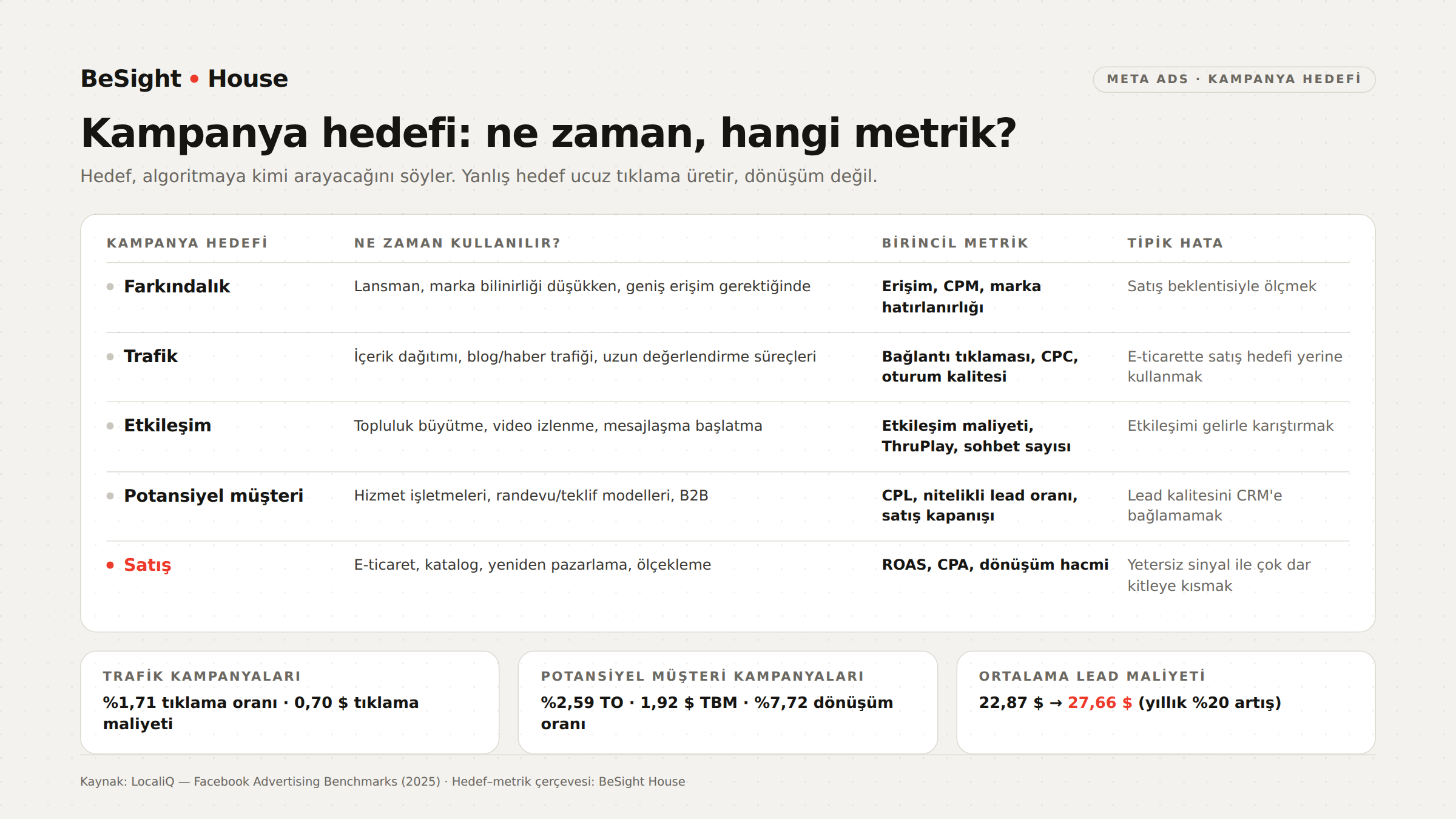
The most expensive mistake is conceptual, not technical: choosing the wrong campaign objective. The objective answers the algorithm’s question, “Who do I need to find?” With a traffic objective, the system looks for users who are likely to click; with a purchase objective, for users who are likely to buy. These are not the same audience.
Here is how it plays out: a traffic campaign generates cheap clicks, the reports look good, and the on-site conversion rate collapses. When the same budget is moved to a sales objective, cost per click goes up but cost per acquisition (CPA) goes down. Buying cheap clicks is an expensive illusion.
| Campaign objective | When to use it | Primary metric | Typical mistake |
|---|---|---|---|
| Awareness | Launches, low brand awareness, when broad reach is needed | Reach, CPM, ad recall | Judging it against sales expectations |
| Traffic | Content distribution, blog/news traffic, long consideration cycles | Link clicks, CPC, session quality | Using it in e-commerce instead of a sales objective |
| Engagement | Community growth, video views, starting conversations | Cost per engagement, ThruPlay, number of conversations | Confusing engagement with revenue |
| Leads | Service businesses, appointment/quote models, B2B | CPL, qualified lead rate, closed deals | Not connecting lead quality to the CRM |
| Sales | E-commerce, catalog, retargeting, scaling | ROAS, CPA, conversion volume | Squeezing into a very narrow audience with insufficient signal |
On the benchmark side, LocaliQ’s 2025 Facebook advertising benchmarks show how differently the objectives behave: in traffic campaigns the all-industry average is a 1.71% CTR and a $0.70 CPC, whereas lead campaigns show a 2.59% CTR, a $1.92 CPC and a 7.72% conversion rate. Average cost per lead has risen 20% year over year, from $22.87 to $27.66. Cost inflation is real; the offset has to come from efficiency.
Advantage+ and machine-learning-driven campaigns
The direction of Meta’s entire product roadmap in recent years can be summed up in one sentence: take the decision away from the advertiser and hand it to the model. The Advantage+ family is the product of that philosophy. When Meta announced Advantage+ shopping campaigns, it reported that advertisers achieved a 12% lower cost per purchase compared with their standard ads.
“AI is driving stronger ad creative and easier campaign optimization.” — Meta Newsroom, 2026: AI Drives Performance
According to Meta, the system’s components are producing concrete gains: in Q4 2025 its ad ranking model GEM drove a 3.5% increase in clicks on Facebook and a 1% increase in conversions on Instagram, while improvements to Meta Lattice translated into a 12% increase in ad quality.
Search Engine Land sums up how the system works:
“Andromeda decides what can be shown, while GEM determines what should be shown next.” — Search Engine Land — Inside Meta’s AI-driven advertising system
The practical upshot: Advantage+ is not a “set it and forget it” button. The model needs three inputs: a clean conversion signal, budget stability and a diverse creative pool. If any of the three is missing, automation simply makes bad decisions faster.
Audiences: broad targeting or detailed targeting?
This debate is mathematical, not ideological. Detailed targeting shrinks the audience; the smaller the audience, the fewer examples there are to learn from and the faster frequency climbs. If your signal infrastructure is strong (Pixel + CAPI), broad targeting usually delivers better results.
The approach that works in practice:
- Start broad: Country, language and a wide age range only. Let the creative do the targeting.
- Use detailed targeting as a hypothesis: Test it in a separate campaign, and don’t make your main volume depend on it.
- Keep retargeting separate: Site visitors, cart abandoners and existing customers should not be mixed with your prospecting budget.
- Keep exclusions disciplined: Excluding too much narrows the audience to the point where the system can no longer learn.
- Build lookalike audiences on data quality: A messy list of 500 people produces a weaker model than a clean list of 50,000.
Your audience strategy is not independent of your organic presence. Accounts that publish consistently provide richer engagement signals, which is why planning social media management and advertising on the same calendar makes a measurable difference. You’ll find the details in our social media management guide.
Why creative is now the most important variable
As targeting levers have been handed over to automation, creative has become the most powerful control an advertiser has left. Andromeda largely evaluates who an ad can be shown to based on creative signals. In other words, creative is the new targeting.
Minimum standards for an efficient creative pipeline:
- Format variety: Produce the same message as a 9:16 Reel, a 4:5 feed ad and a 1:1 carousel. Chasing scale with a single format leaves most of the inventory out.
- Video first: The problem or the result should be visible within the first 3 seconds; add captions on the assumption that it will be watched without sound.
- UGC and testimonials: Studio shoots build trust, while user-generated content blends naturally into the feed. Rotate both.
- Message variety: Price, benefit, objection handling, social proof, moment of use — each should be tested as a separate angle.
- Refresh cadence: When frequency rises and CTR falls, creative fatigue has set in; have the next variant ready before you need it.
No matter how good the ad is, if the post-click experience is poor, the budget melts away. A slow-loading landing page or one with a long form drives CPA up directly. That is why, alongside your creative investment, you also need to review your corporate web design; our conversion-focused web design guide covers this in detail.
Meta Pixel, the Conversions API (CAPI) and iOS privacy changes
Meta’s own developer documentation describes the Meta Pixel as “a piece of JavaScript code that lets you track visitor activity on your website”, and it does three jobs: measuring ad effectiveness, optimizing targeting and analyzing the conversion funnel.
But the Pixel alone is no longer enough. Browser-based tracking loses data to ad blockers, cookie restrictions and operating-system-level privacy controls. Apple’s App Tracking Transparency was the most visible example. Dave Wehner, Meta’s CFO at the time, summed up the impact like this:
“It’s on the order of $10 billion, so it’s a pretty significant headwind.” — CNBC — Facebook says Apple iOS privacy change will cost $10 billion
The solution is server-side measurement. As Meta defines it, the Conversions API (CAPI) creates a connection that carries marketing data “from an advertiser’s server, website platform, mobile app or CRM to Meta systems”, and its purpose is stated plainly: to optimize targeting, lower cost per result and measure outcomes. Meta processes server events in the same way as Pixel data.
Implementation checklist:
- Run Pixel and CAPI together, and always set up
event_idmatching for event deduplication. - Verify your domain and prioritize events in Aggregated Event Measurement according to your business goal.
- Improve match quality with advanced matching (hashed email, phone number).
- Monitor the Event Match Quality score in Events Manager regularly; a low score translates directly into a higher CPA.
- Combine server-side events with your CRM and send not just leads, but qualified lead and sales signals.
The learning phase and budget stability
Every new ad set goes through a learning phase. According to the mechanics described by Social Media Examiner, an ad set should ideally generate around 50 optimization events within 7 days to exit this phase. Until that threshold is reached, results fluctuate.
“your results will be unstable as Facebook learns how best to deliver your ads” — Social Media Examiner — How to Exit the Facebook Ads Learning Phase Quicker
According to the same source, the main interventions that reset the learning phase are: increasing or decreasing the budget by more than 20% within 72 hours, changing the audience in the ad set, and adding new ads to an existing ad set. In other words, the “let me just tweak it a little” reflex restarts learning and drives costs up.
Budget discipline: Instead of doubling the budget, scale in increments of no more than 20% every 2–3 days. Rather than duplicating ad sets, use campaign-level budgets to consolidate the signal in one place. If your target event doesn’t reach 50 per week, optimize for an event one step higher in the funnel.
A/B testing discipline: hypothesis, variable, decision
Testing in Meta Ads is not “launch two ads and see what happens.” A working test discipline rests on these rules:
- One variable: If you change the creative, the audience and the bid strategy at the same time, you can’t interpret the result.
- Enough time: A decision made before the learning phase is complete is just noise. A minimum of 7 days, ideally 10–14.
- Enough volume: Declaring a “winner” based on 12 conversions is meaningless.
- Run variants simultaneously: Sequential tests are skewed by seasonality; Meta’s built-in A/B testing tool splits the audience.
- Keep a record: The hypothesis, date and decision belong in a test log; accounts without a memory repeat the same test three times a year.
Prioritize your tests in the right order: creative angle first, then format, then landing page, with bid strategy and audience last. The size of the impact usually follows this order.
Measurement: ROAS, CPA and an incrementality lens
The ROAS shown in Ads Manager is an estimate, not the whole truth. A sound measurement framework reads three layers together:
- In-platform metrics: ROAS, CPA, CTR, frequency, CPM. Necessary for day-to-day optimization, but not the final arbiter.
- Business metrics: Total revenue, gross profit, blended CAC (total marketing spend ÷ total new customers) and customer lifetime value (LTV). The final decision is made at this layer.
- Incrementality measurement: The answer to the question, “Would this sale have happened without this ad?” According to Meta’s own data, its incremental attribution feature can report 24% more incremental conversions than the standard model — which shows that the choice of attribution model alone changes reported performance.
In practice, three habits pay off: geo holdout tests, channel pause experiments and logging “How did you hear about us?” survey answers in your CRM. To see how channels feed each other, we recommend reading our Google Ads campaign management guide alongside this one. The shift of search visibility into AI interfaces is a separate measurement topic, which we cover in our GEO service and in our article on AI search visibility.

KVKK and advertising regulation in Turkey
Legal compliance is now part of the technical setup. In Turkey, the processing of personal data falls under Law No. 6698 on the Protection of Personal Data (KVKK); the Pixel, CAPI, custom audience uploads and cookie-based retargeting all need to be assessed within this framework. Key points to watch: a separate, clearly written privacy notice, valid consent collected through a cookie tool, a legal basis for uploaded lists and defined data retention periods.
On the ad content side, regulations from the Turkish Ministry of Trade are decisive. The Ministry has extended its transparent advertising rules on social media, making it mandatory to clearly label content shared in exchange for payment, products, discounts, invitations or sponsorship; this requires the use of terms such as “reklam” (advertisement), “iş birliği” (collaboration), “sponsorlu içerik” (sponsored content) or “tanıtım” (promotion). For brands that rerun influencer collaborations as Meta ads, this labeling obligation applies directly.
Common Meta Ads mistakes
- The wrong campaign objective: Running a traffic or engagement objective while expecting sales.
- An over-fragmented account structure: Dozens of ad sets, each stuck in the learning phase.
- Daily tinkering: Changing the budget by more than 20% within 72 hours and constantly resetting learning.
- Chasing scale with a single creative: Not producing new variants as frequency rises.
- Relying on the Pixel alone: Ignoring signal loss by not setting up CAPI.
- Restricting placements unnecessarily: Shutting out cheaper inventory through manual placement selection.
- Neglecting the landing page: Optimizing the ad while leaving the conversion path untouched.
- Relying on a single source for measurement: Making budget decisions without questioning platform ROAS.
Most of these mistakes are process problems, not budget problems. The operation we run for Meta Ads management brings objective selection, signal infrastructure, the creative calendar and a weekly testing rhythm together in a single framework. You can browse examples on our our work page.
Frequently asked questions
What should the minimum monthly budget for Meta Ads be?
There is no hard floor; what matters is the cost of your target event. To exit the learning phase, an ad set needs to generate roughly 50 optimization events per week. In the Turkish market, for example, if your target CPA is 200 TL, that means roughly 10,000 TL in weekly volume for a single ad set. If your budget falls short, optimize for an event higher up the funnel.
Is Advantage+ or a manual campaign better?
When it announced Advantage+ shopping campaigns, Meta reported a 12% lower cost per purchase compared with standard ads. However, that advantage materializes in accounts with a clean conversion signal and a varied creative pool. The soundest approach is to run both in parallel and shift budget based on results.
Does Instagram or Facebook perform better in Turkey?
Instagram is far ahead on reach: according to DataReportal, Instagram’s ad reach in Turkey is 62.3 million (70.9%), versus 34.7 million (39.5%) for Facebook. However, men make up 64.4% of Facebook’s ad audience, so it remains an efficient source of volume in male-skewed categories.
If the Pixel is already installed, do I really need CAPI?
Yes. Browser-based tracking loses data because of cookie restrictions and operating-system-level privacy controls; Apple’s ATT change was announced to have a revenue impact of roughly $10 billion on Meta for 2022. Meta processes server events in the same way as Pixel data and defines CAPI’s purpose directly as “lowering cost per result.”
How often should I refresh my ads?
Watch the signals rather than the calendar. If click-through rate falls and CPM rises as frequency climbs, creative fatigue has set in. In active accounts, a practical rhythm is to produce at least 2–3 new creative variants per week and gradually switch off the ones whose performance is slipping.
Should I run Meta Ads and Google Ads at the same time?
For most businesses, yes. Meta creates demand; search captures the demand that results. Evaluating both through blended CAC instead of measuring them separately leads to far better budget allocation decisions. On the organic side, not neglecting SEO fundamentals reduces your dependence on ads over the long term.
Sources
- DataReportal — Digital 2026: Turkey
- Meltwater & We Are Social — Digital 2026: Internet Users Pass 6 Billion
- Meta Investor Relations — Meta Reports Second Quarter 2026 Results
- Meta Newsroom — 2026: AI Drives Performance
- Meta Newsroom — Introducing New Automation Tools to Increase Sales and Drive Growth
- Meta for Developers — Conversions API
- Meta for Developers — Meta Pixel
- Search Engine Land — Inside Meta’s AI-driven advertising system: How Andromeda and GEM work together
- Social Media Examiner — How to Exit the Facebook Ads Learning Phase Quicker
- LocaliQ — Facebook Advertising Benchmarks
- CNBC — Facebook says Apple iOS privacy change will result in $10 billion revenue hit
- Republic of Türkiye Ministry of Trade — A New Era of Transparent Advertising on Social Media (in Turkish)
Want to turn your Meta Ads account into a growth-focused system? At BeSight House, we design your objective architecture, Pixel and CAPI setup, creative production calendar and incrementality measurement framework as one system. Explore our Meta Ads service or get in touch for a free preliminary review of your current account.